Mohair teddy bears
Mohair is a pile fabric woven from the hair of the angora goat. It has been the classic teddy bear material since the very first Steiff bears of 1903, and it is still what most collectors picture when they think of a "real" teddy bear.
What mohair fabric is
Mohair comes from the angora goat, not the angora rabbit. For bear making the yarn is woven into a cotton backing as a pile, a little like velvet with long hair. Only a few mills make bear mohair, the best known of them in Germany.
The same fibre gives very different bears depending on the finish:
- Straight — smooth, even pile, the classic look.
- Distressed — pile set at different angles for an old, well-loved look.
- Sparse — less pile per square centimetre, so the backing shows through; used for vintage-style bears.
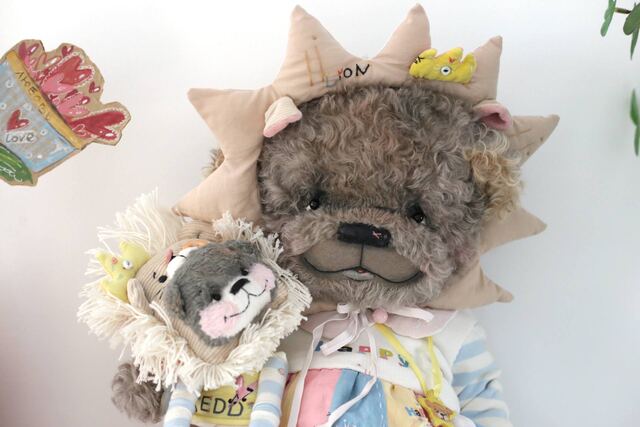
- Curly and tipped — curled pile or pile with darker or lighter tips.
Pile length runs from a few millimetres to several centimetres. Short pile suits small bears; long pile gives a large bear its soft outline.
Mohair, viscose, alpaca and plush
| Fabric | Made from | Character |
|---|---|---|
| Mohair | angora goat hair | springy, lustrous, holds a sculpted shape; takes trimming and tinting |
| Viscose | cellulose fibre | very soft, drapes and flops, silky sheen; good for small bears |
| Alpaca | alpaca wool | dense, soft and matte; the priciest |
| Synthetic plush | polyester | cheap and washable; the fabric of ordinary toys |
Fabric names used in bear descriptions are collected in the glossary.
How to tell a mohair bear
- Part the pile. Mohair sits in a woven backing that you can see at the roots. Many synthetics are knitted.
- Look at the light. Mohair has a natural lustre rather than a plastic shine.
- Press it. Mohair springs back; cheap plush stays flat.
- Read the description. An artist names the material, often down to the mill. "German mohair" is a common and meaningful phrase.
Old bears are a separate story: on an antique bear the mohair may be worn down to the backing, and that wear is part of its history and value. Valuing an old collection is covered in what a teddy bear collection is worth.
Why mohair bears cost more
The fabric itself costs many times more than synthetic plush. It is also slower to work: the pile has to be combed out of every seam, the muzzle is trimmed by hand with scissors, and a large bear may be tinted to add depth. The result lasts: a mohair bear stuffed with wood wool does not shed or yellow and can stay in a family for a century. More on pricing in why artist bears cost what they cost.
Caring for mohair
Mohair is a natural animal fibre, so it is dusted with a soft brush rather than washed, kept out of direct sun and protected from moths. Step by step: how to care for a collectible teddy bear.
Mohair in Tonya's bears
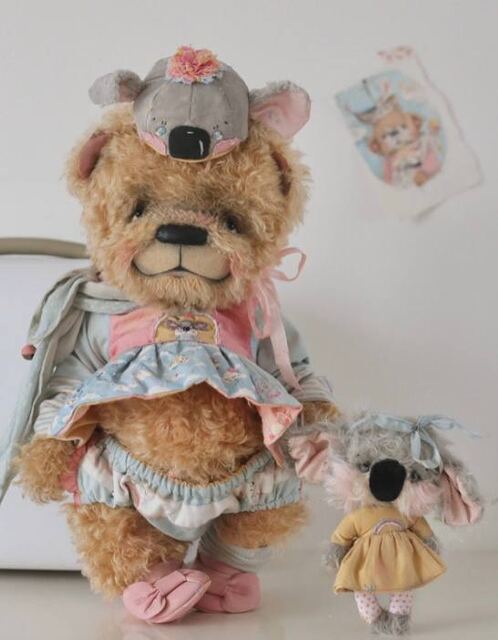
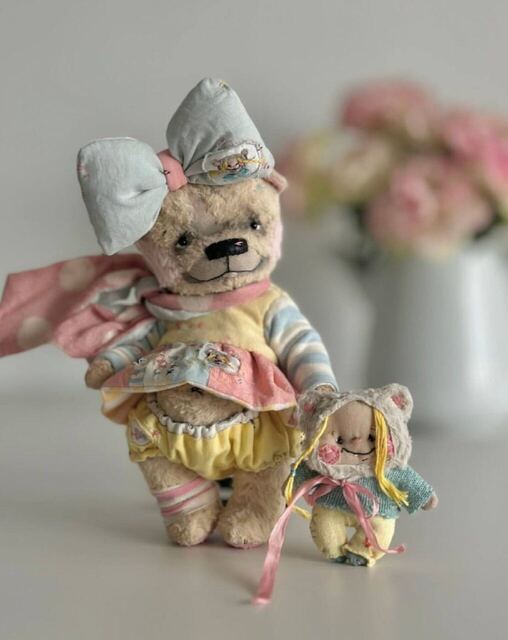
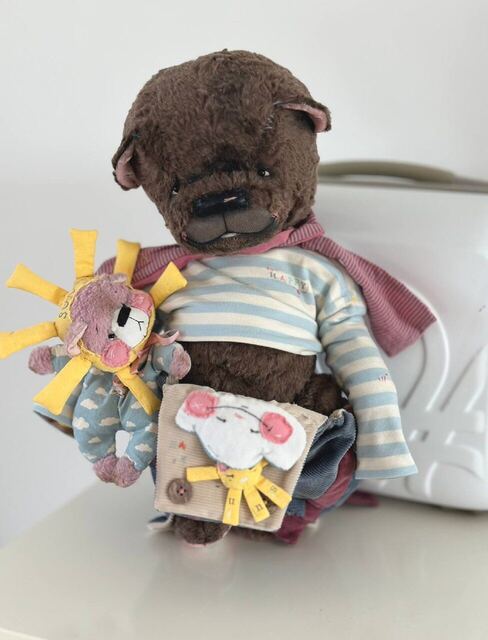
In Antonina Vakhrushina's collection the large bears, 44–45 cm, are sewn from German mohair: Brownie, Leo and the Bear with a Koala. They are stuffed with wood wool, have glass eyes, and Brownie and Leo carry a growler inside. Smaller bears are made of German viscose, which suits their size. The mohair bears are the most elaborate pieces, at around €1,200–1,300; the viscose bears are around €480. All of them are one of a kind; see what is available now in the collection.
Frequently asked questions
What is mohair on a teddy bear?
A pile fabric woven from the hair of the angora goat on a cotton backing. It has been the classic teddy bear fabric since the first Steiff bears of 1903.
Is mohair better than viscose for a teddy bear?
Neither is better, they are different. Mohair is springy and holds a sculpted shape, which suits larger bears; viscose is softer and drapes, which suits small ones.
Why are mohair teddy bears expensive?
Bear mohair costs many times more than synthetic plush, and it takes longer to work: the pile is combed out of every seam and the muzzle is trimmed by hand.
Can a mohair teddy bear be washed?
It is better not to. Mohair is dusted with a soft brush, kept out of direct sun and protected from moths.
What this looks like in practice
Every piece exists once, so there are never many available at a time. The bears that have found homes are kept here on purpose: they show what the work is like and what will appear next.